The Collins estate in Greenwich, Connecticut, looked like something out of a magazine—golden lights wrapped around ancient oak trees, wreaths hung on arched windows, and a 14-foot Christmas tree standing proudly in the marbled foyer. But despite all the luxury, the air felt cold—and not because of the December snow.
I had spent five years trying to earn a place in the Collins family. My husband, Harrison, was born into old money, and everything in their world revolved around reputation, tradition, and perfection. Unfortunately, my children and I didn’t fit that picture.
My four-year-old daughter, Aria, walked beside me, wearing a little emerald velvet dress I had saved for weeks to buy. My seven-year-old son, Oliver, followed quietly—observant, thoughtful, and wise beyond his years.
We entered the grand dining room, where Eleanor Collins—Harrison’s mother—sat at the head of the table, elegant as a queen and twice as intimidating.
“Mommy,” Aria whispered, “can I help with the drinks? I want Grandma to like me.”
Before I could respond, Eleanor’s eyes flicked toward us. “Yes, let’s see if she’s capable of something useful,” she said sharply.
Aria, wanting to impress her grandmother, reached for the crystal water pitcher. I opened my mouth to warn her—but it was too late.
Her little feet caught on the edge of the Persian rug.
The pitcher slipped.
Water splashed across the floor.
Silence.
“Oh no…” Aria whimpered.
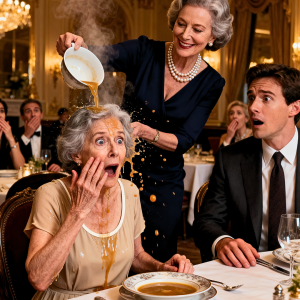
Eleanor rose slowly, her expression tightening. In a flash before I could react, her hand slapped across Aria’s cheek—hard. The sound echoed across the room.
“You careless little brat!” she hissed.
I rushed forward, but Eleanor grabbed Aria by the hair.
“No!” I screamed—

Too late.
She slammed my daughter’s head against the mahogany table corner.
Aria crumpled to the floor—crying, shaking, a thin line of blood tracing down her forehead.
“ELEANOR!” I yelled, clutching my daughter.
I turned to Harrison, desperate for support.
He… laughed.
“She needs to learn consequences,” he said calmly. “That’s how this family works.”
My breath caught in disbelief. The whole Collins family continued eating as if nothing had happened.
Then, something unexpected happened.
Oliver stood.
His voice was small—but it carried.
“Grandma hurt Aria. And I know what she did before.”
Harrison snapped, “Oliver, sit. down.”
But my son didn’t move.
“I know what really happened to Aunt Audrey.”
The entire room froze.
Franklin Collins’ fork slipped from his hand.
“What did you say?” Eleanor whispered.
Oliver swallowed, voice trembling but determined.
“You said she didn’t fall down the stairs. You said… you pushed her.”
Gasps filled the air.
Franklin stood up abruptly. “Enough! No one says another word!”
But Oliver wasn’t finished.
“Grandma killed Aunt Audrey.”
Almost as if summoned by his words, sirens wailed in the distance.
Eleanor turned pale.
The room erupted—questions, shouting, denial.
I lifted Aria into my arms and turned to Harrison.
“We’re leaving. Now.”
“You’re being dramatic,” he muttered, now more embarrassed than concerned.
“If you don’t walk out with us this minute,” I said quietly, “I will file for divorce in the morning.”
Oliver took my hand. “Come with us, Dad,” he whispered.
For the first time that night—Harrison hesitated. Something in his expression cracked.
He followed.
Franklin shouted after us, “If you leave now, you’re cut off from everything!”
I stopped at the door.
“We want nothing from you.”
That night, the hospital stitched Aria’s wound and documented everything. A social worker was notified. Police took statements.
And by morning—our story was on the news.
Detective Marcus Flynn visited a few days later and spoke gently to Oliver.
“What exactly did you hear?”
Oliver spoke carefully. “Grandma said she had to protect the family name. Aunt Audrey was going to tell the police Grandpa stole money.”
That was enough to reopen a 15-year-old case.
Within a week, Franklin and Eleanor Collins were arrested. Fraud. Assault. Potential homicide.
The Collins empire—built on lies—began to crumble.
During the trial, the truth emerged: Audrey had discovered Franklin’s embezzlement. She confronted Eleanor. They fought. Audrey died—not from a fall, but from being struck against a sharp surface.
Eleanor was sentenced to 25 years to life. Franklin got 12.
Harrison tried to make amends. He went to therapy. He apologized. But it was too late.
We divorced.
The kids and I moved to a small townhouse in Vermont. No chandeliers. No expectations.
Just peace.
One night, Oliver whispered, “Mom… was it my fault?”
I pulled him close.
“Oliver, you didn’t break anything,” I said softly. “You stopped something wrong from continuing.”
Last Christmas, we decorated our tiny living room with paper snowflakes, homemade garlands, and laughter.
Aria’s little scar faded. Oliver smiled more.
Our life isn’t perfect.
But it is ours.
Safe. Free. Honest.
Because sometimes, the smallest voice tells the biggest truth.